
This day in Aviation History: January 8th 1944 – First flight of the Lockheed P-80 Shooting Star.
The Lockheed P-80 Shooting Star was the first jet fighter used operationally by the United States Army Air Forces (USAAF). Designed and built by Lockheed in 1943 and delivered just 143 days from the start of the design process, production models were flying but not ready for service by the end of World War II. Designed with straight wings, the type saw extensive combat in Korea with the United States Air Force(USAF) as the F-80.
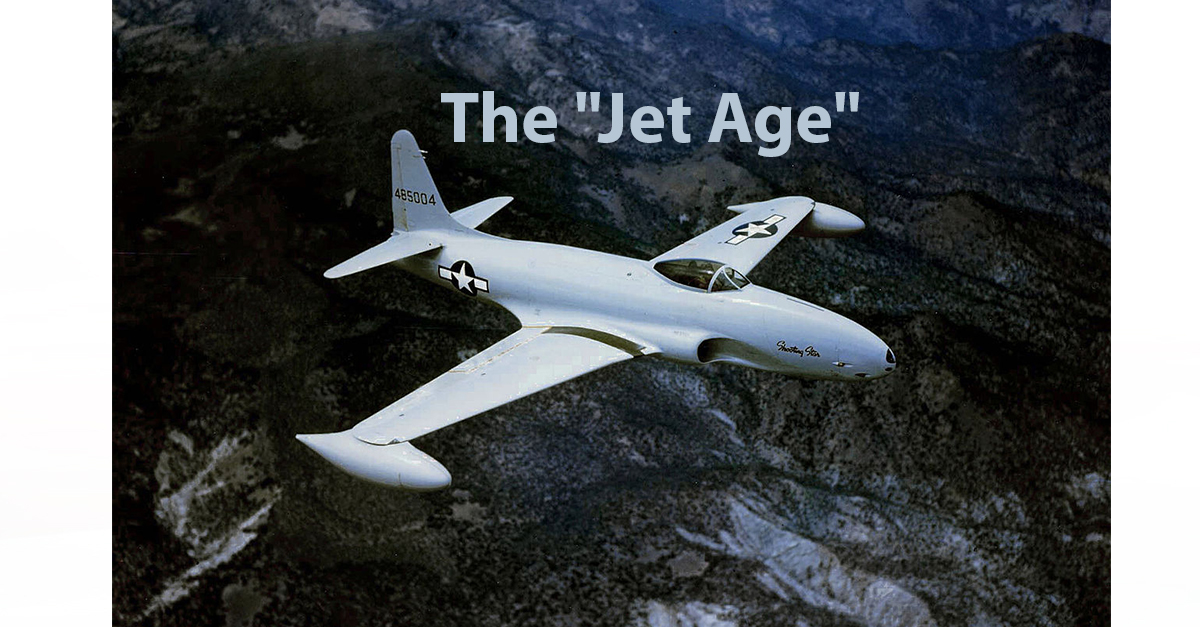
America’s first successful turbojet-powered combat aircraft, it helped usher in the “jet age” in the USAF, but was outclassed with the appearance of the swept-wing transonic MiG-15 and was quickly replaced in the air superiority role by the transonic North American F-86 Sabre. The F-94 Starfire, an all-weather interceptor on the same airframe, also saw Korean war service. The closely related T-33 Shooting Star trainer would remain in service with the U.S. Air Force and Navy well into the 1980s, with the last NT-33 variant not retired until April 1997. Many still serve in a military role in foreign air arms or are in private hands.
The XP-80 had a conventional all-metal airframe, with a slim low wing and tricycle landing gear. Like most early jets designed during World War II—and before the Allies captured German research data that showed the speed advantages of swept-wings—the XP-80 had straight wings, similar to previous propeller-driven fighters. It was the first operational jet fighter to have its engine in the fuselage, a format previously used in the pioneering German Heinkel He 178 V1 of 1939, and the slightly later British Gloster E.28/39 demonstrator of 1941. Other early jets generally had two engines because of their limited power, these being mounted in external nacelles for easier maintenance. With the advent of more powerful British jet engines, fuselage mounting was more effective, and it was used by nearly all subsequent fighter aircraft.
Concept work began on the XP-80 in 1943 with a design being built around the blueprint dimensions of a British Halford H-1 B turbojet (later called the de Havilland Goblin), a powerplant to which the design team did not have actual access. Lockheed’s team, consisting of 28 engineers, was led by the legendary Clarence L. “Kelly” Johnson. This teaming was an early product of Lockheed’s Skunk Works, which surfaced again in the next decade to produce a line of high-performance aircraft beginning with the F-104.
See all our vintage style Fighter Aircraft Artwork HERE at Squadron Posters!